
A Moringa tree is extremely beneficial for any garden, so if you want to know how to grow moringa tree from cutting, this guide explains the best propagation methods step-by-step.
Moringa, also called the Miracle Tree or Drumstick Tree, is a fast-growing, drought-tolerant plant known for its exceptional nutritional and medicinal value.
Almost every part of the tree is useful:
- Leaves are rich in vitamins, iron, calcium, and antioxidants
- Pods are widely used in cooking and soups
- Seeds produce valuable moringa oil
- Flowers are used in traditional herbal remedies
Because of its rapid growth and usefulness, many gardeners prefer propagating moringa trees from cuttings instead of seeds.
This method helps you grow a new plant faster and with the same traits as the parent tree.
Quick Answer
To grow a moringa tree from cutting, take an 8–10 inch healthy branch with at least two nodes and plant it in moist soil or water until roots develop.
The soil propagation method is the most reliable, but moringa can also be propagated using:
- Soil planting
- Water rooting
- Grafting
- Air layering
Roots usually develop within 2–4 weeks in warm conditions.
Why Grow Moringa From Cuttings?
Growing moringa from cuttings has several advantages compared to seed propagation.
| Benefit | Explanation |
|---|---|
| Faster Growth | Cuttings grow quicker than seedlings |
| Genetic Copy | New plant is identical to the parent |
| Earlier Harvest | Leaves and pods can be harvested sooner |
| Easy Propagation | Requires very basic gardening tools |
| Cost Effective | No need to buy seeds |
For home gardeners, cuttings are the easiest way to multiply moringa trees quickly.
Best Conditions for Moringa Cutting Propagation
Before starting propagation, it is important to provide the right growing environment.
| Growing Factor | Ideal Condition |
|---|---|
| Temperature | 25°C – 35°C |
| Sunlight | Bright indirect sunlight |
| Soil | Well-draining sandy soil |
| Water | Moderate watering |
| Humidity | Medium humidity |
Moringa thrives in warm climates and well-draining soil, which is why it is widely grown in tropical and subtropical regions.
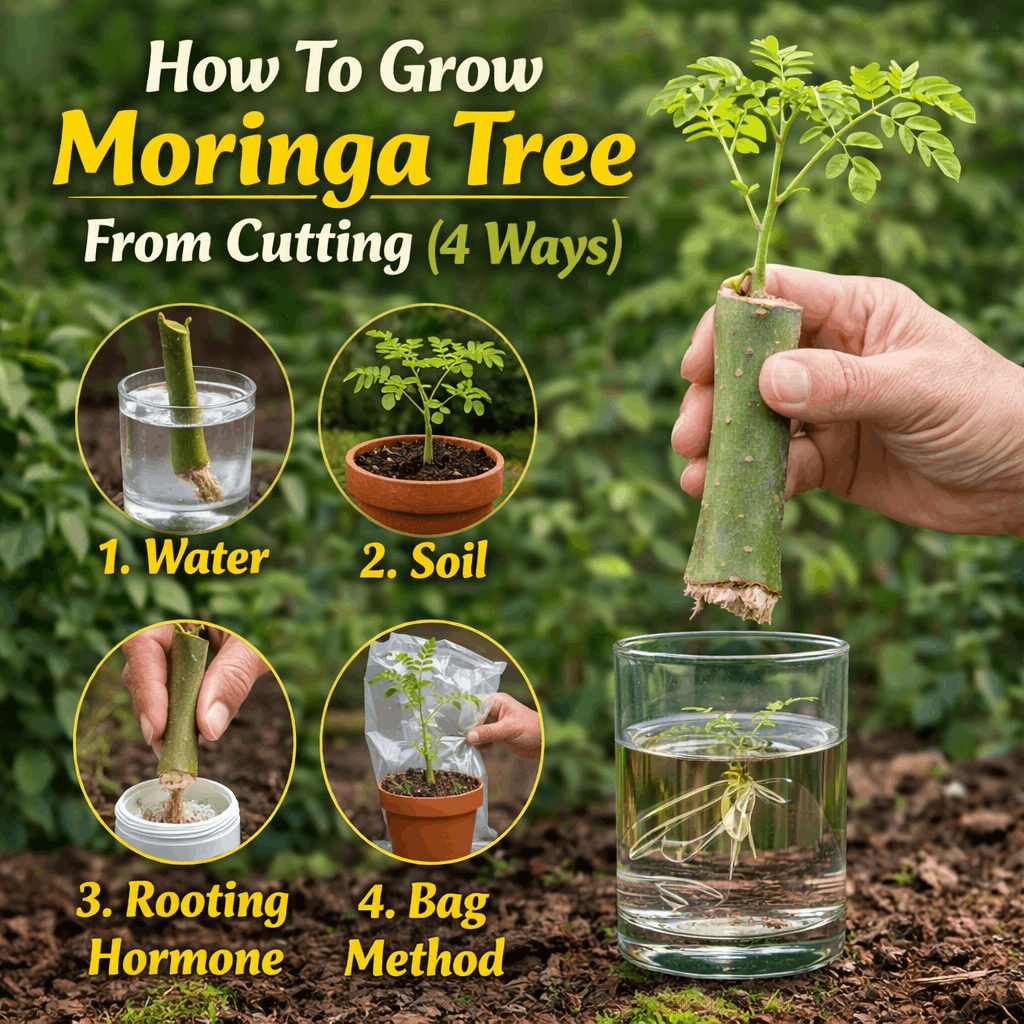
How To Grow Moringa Tree From Cutting (4 Ways)

There are four common propagation methods used to grow a Moringa tree from stem cuttings:
- Soil propagation
- Water propagation
- Grafting method
- Air layering
Let’s look at each method in detail.
1. Moringa Tree: Soil Propagation
Here’s a detailed method for growing a Moringa tree cutting in soil:
Things you need:
- A healthy Moringa cutting
- A pot with drainage holes
- Potting soil
- Rooting hormone powder (optional)
- Water
What To Do?
- Choose a healthy Moringa cutting that is about 8-10 inches long, with at least two nodes (where leaves or branches emerge from the stem). Make sure the cutting is free from any signs of disease or pests.
- Potting soil should be poured into a pot, providing around an inch of room at the top.
- Bury the clipping in the soil.
- To hold the Moringa cutting in place, insert it in the hole and gently push the surrounding earth.
- Hydrate the cutting thoroughly, trying to ensure the ground is damp but not soggy.
- To make the chopping process more comfortable, wrap the pot in plastic wrap or a plastic bag. This will aid in keeping it.
- Routinely monitor the clipping to make sure the soil is still moist.
- The Moringa clipping should begin to grow foliage in around a month; this shows that it has effectively rooted. You can take off the plastic wrap once the plant has developed roots and progressively introduce it to more sunshine.
- One can either plant the clipping into the soil right away or into a larger container once it has developed into a little tree.
Growing a Moringa tree from a cutting can be a bit challenging, but with the right conditions and care, it is a rewarding and cost-effective way to propagate the plant.
- Also, read- How To Propagate Rhododendrons From Cutting
- Moringa Seed Germination: Easy 5 Steps, Spacing, Yield
2. Moringa Tree: Water Propagation
Here is the process for growing Moringa cuttings in water:
Materials:
- A Moringa cutting
- A clear jar or vase
- Water
- Rooting hormone powder (optional)
Instructions:
- Pick a good healthy, 8–10-inch-long Moringa branch that has at least two terminals. Verify the cutting is clear of any illness or pest traces.
- Fill a clear jar or vase with water, and make sure the water level is high enough to submerge the bottom node of the cutting.
- Place the Moringa cutting in the jar or vase, making sure that the bottom node is submerged in the water.
- If necessary, use a weight or a piece of tape to hold the cutting in place so that it remains submerged in the water.
- Constantly assess the water quantity and top it off as necessary to maintain the cutting’s bottom node immersed.
- After about 2-4 weeks, the Moringa cutting should start to develop new roots, which indicates that it has successfully rooted. Once the roots have grown, one can either transfer the plant into the ground or keep growing it in water.
- If you choose to transplant the cutting into soil, fill a pot with potting soil, and make a hole in the center. Insert the cutting inside the hole after carefully removing it from the water.
- Water the ground well after covering the base with soil. As the roots grow, keep taking care of it by keeping the container in a hot, bright spot that is not in full light.
Growing Moringa cuttings in water can be a fun and easy way to propagate the plant and can also serve as a decorative display. Just make sure to keep an eye on the water level and provide the right conditions for the cutting to root successfully.
3. Moringa Tree: Grafting Method
Grafting is a technique used to propagate plants by fusing a stem cutting from one plant (the scion) onto the rootstock of another related plant.
Here’s how to use grafting to propagate a Moringa stem cutting:
Things You Need:
- A healthy Moringa scion (a stem cutting with at least two nodes and no flowers or buds)
- A Moringa rootstock plant of a similar age and size
- A sharp knife or grafting tool
- Grafting tape or plastic wrap
- Rooting hormone powder (optional)
What To Do?
- Choose a wholesome Moringa scion and a Moringa rootstock plant that are the same size and age. The rootstock needs to have strong roots and a stem.
- Make an even, diagonal cut at the base of the scion, close to a junction, using a paring blade or grafting tool.
- Make an identical cut immediately above a terminal at the top of the rootstock stem.
- Make sure the cuttings on the scion and rootstock fit tightly together.
- To promote root growth, you can sprinkle rooting hormone powder on the cut surface of the scion.
- Grafting tape or plastic wrap should be used to completely enclose the grafting spot. The two stems will be held together and kept clean and pest-free by doing this.
- Place the grafted plant in a warm, humid location with indirect light, and keep the soil moist but not waterlogged. It’s essential to maintain the soil in damp conditions but not soggy because too much moisture might lead to rot.
- After about 2-4 weeks, the scion should start to form new leaves, which indicates that the graft has been successful. The grafting tape or plastic wrap can indeed be taken off after the scion has entrenched itself.
- Continue to care for the grafted plant as it grows, making sure to provide it with enough light, water, and nutrients.
Grafting can be a challenging technique, but it can also be a very effective way to propagate Moringa plants. Just make sure to choose healthy scions and rootstocks and to take care to ensure a clean and snug fit between the two stems.
4. Moringa Tree: Air Layering
Air layering is a technique used to propagate plants by inducing the development of roots on a stem that is still attached to the parent plant.
Here’s how to use air layering to grow a Moringa tree from its stem cuttings:
Materials:
- A healthy Moringa stem cutting
- Sphagnum moss or peat moss
- Plastic wrap or aluminum foil
- Twine or garden ties
- Rooting hormone powder (optional)
- A sharp knife or pruning shears
Instructions:
- Choose a healthy Moringa stem cutting that is about 1/2 to 1 inch thick, with at least one node and several leaves.
- Make a horizontal cut and make sure to cut through the bark and into the inner wood.
- Remove any leaves or buds from the area below the cut, leaving only a few leaves at the top of the stem.
- If desired, apply rooting hormone powder to the cut area to encourage root growth.
- Moisten a handful of sphagnum moss or peat moss, and wrap it around the cut area, making sure to cover the entire cut surface.
- Wrap the moss-covered area with plastic wrap or aluminum foil, making sure to cover it completely and seal the edges.
- Tie the plastic wrap or aluminum foil in place with twine or garden ties, making sure it is secure but not too tight.
- Wait 4-6 weeks for roots to develop. Check regularly to make sure the moss is still moist, and add water if necessary.
- Once roots have developed, cut the stem below the new root ball, and carefully remove the plastic wrap or aluminum foil and moss.
- Plant the rooted cutting in a pot or in the ground, making sure the roots are covered with soil.
Air layering propagation can be a useful technique for propagating Moringa plants, as it allows you to grow a new plant from a stem cutting without removing it from the parent plant.
Only pick a healthy cutting and take care to keep the moss damp and the plastic wrap or aluminum foil tightly sealed.
Best Method to Grow Moringa Tree From Cutting
Among all propagation techniques, soil propagation is the most effective method.
| Method | Difficulty | Success Rate |
|---|---|---|
| Soil Propagation | Easy | High |
| Water Propagation | Easy | Medium |
| Grafting | Advanced | Medium |
| Air Layering | Moderate | High |
For beginners, planting cuttings directly in soil works best.
Common Mistakes When Growing Moringa From Cuttings
Avoid these mistakes to improve success rate:
- Using weak or diseased cuttings
- Overwatering the cutting
- Planting in heavy clay soil
- Keeping the cutting in direct harsh sunlight
- Not maintaining humidity
Healthy cuttings and warm conditions are the key to successful propagation.
Can moringa grow from cuttings?
Yes. Moringa grows very easily from stem cuttings. A healthy branch planted in soil can develop roots within 3–4 weeks.
What size cutting is best for moringa propagation?
The best cutting size is 8–12 inches long with at least two nodes.
How long does moringa cutting take to root?
Most moringa cuttings start rooting within 2–4 weeks in warm conditions.
Can moringa cuttings grow in water?
Yes. Moringa cuttings can root in water before being transplanted into soil.
What soil is best for moringa trees?
Moringa grows best in well-draining sandy or loamy soil.
Wrapping It Up
The Moringa tree is one of the most valuable plants you can grow in your garden due to its nutritional, medicinal, and environmental benefits.
If you want to propagate moringa, stem cuttings are the easiest and fastest method.
There are four main ways to grow a moringa tree from cutting:
- Soil propagation
- Water propagation
- Grafting
- Air layering
Among these, the soil method offers the highest success rate and easiest process, making it ideal for beginner gardeners.
With proper care, sunlight, and moisture, your moringa cutting can grow into a healthy tree within a few weeks.

I am an enthusiast who loves plants very much and I do a lot of research online as well as outside in gardens and nurseries. I also strive to be as accurate as possible in my research and my articles. I have been involved in gardening for a long time and truly enjoy it. Know more about me About. You can also join me Here.