
A Small Orange Fruits On The Tree? Citrus sinensis, often known as the sweet orange, has been the largest recurrently cultivated citrus variety throughout the entire globe. It thrives in vegetation hardiness areas 9 through 10.
What causes a small fruits on your orange tree? It’s a common citrus problem, Small fruit issues suggest nutritional deficiency, insect infestations, or illness has strained your tree. Orange trees are highly regarded for their deep green leaves, scented blooms, and delicious fruit, so it might be disheartening whenever the fruit yielded by your tree seems much smaller than usual.
With appropriate maintenance, you can keep your orange trees fit, active, and vibrant, then you’ll have fewer difficulties. I have included a handful of the top typical issues that orange trees face in today’s post.
Orange Description/Profile

Even though an orange tree is reasonably straightforward to discern when it is packed with fresh oranges, it might be difficult to discern when there’s not much fruit on the tree.
Any orange tree may be identified by its size and form, including its foliage.
For simpler recognition, the following are the basic features of the Orange tree:
Shape and Size
- Any orange tree grows to be around 25 feet in height on average, however, a really old tree can grow to be close to 50 feet in height.
- The tree’s entire crown structure is circular and made up of thin shoots if observed from above. Because orange trees are perennial, their leaves are usually apparent at all times.
Fruit
- Each orange plant’s fruit is typically circular in shape (Like Green Lemons) and measures between 2.5 – 3.75 inches in diameter.
- The mature orange fruit’s peel is usually orange, although it can appear yellow as well. The overall surface is covered in microscopic oil glands.
- Once the peel is ripped apart, it reveals a mushy, whitish interior coating.
- The fruit within ranges in color from mostly yellow and red, more so, the orange fruit is made up of 10–14 wedge-shaped vesicles that are each loaded with flesh plus juice.
- Although some kinds are seedless, every vesicle can hold approximately four seeds.
Leaves
- Each petiole of orange tree foliage occasionally has little wings on them. They might be highly noticeable or quite subtle.
- The orange tree foliage is stretched ovals that range in size between 2.5 to 6 inches in length as well as 1 to 3.75 inches in width.
- The orange tree leaves have pointed tips that might or might not have a modest serration around the margins.
Branches
- The young shoots (branches) of orange trees are slanted as well as bent.
- With slender, somewhat dull semi-flexible stalks in which the petiole, the little stem which bears the foliage, connects to the shoots.
Flowers
- Each orange tree’s blossoms measure around 2 inches in diameter. They emerge single on occasion, however, they can alternatively emerge in little bunches of 2 to 6 flowers.
- Every calyx, a green component of the flower that retains it in place, possesses five points. Five whitish rectangular petals make up each orange tree blossom.
- There are approximately 20 to 25 filaments inside the blossom, which are capped with highly visible fatty anthers.
Reasons For Small Orange Fruits On The Tree?
Small orange fruit atop orange trees can be induced by a number of diverse variables.
The nutritional difficulty, water strain, as well as insect infestation or illness are all possible reasons for tiny fruit on orange trees.
Continue reading to get an outline of the reasons for your tree’s little orange issue.
Quick Diagnosis Table: Why Orange Fruits Stay Small
Many gardeners notice their orange tree producing fruit, but the fruits stay much smaller than expected. The table below summarizes the most common causes and quick solutions.
| Problem | Visible Symptoms | Main Cause | Quick Solution |
|---|---|---|---|
| Irregular watering | Small fruit, fruit drop, dry soil | Water stress | Deep watering every 7–10 days |
| Nutrient deficiency | Yellow leaves, poor fruit growth | Lack of zinc, nitrogen, iron | Apply citrus fertilizer |
| Pest infestation | Leaf damage, distorted fruit | Mites, aphids, scales | Use neem oil or insecticidal soap |
| Poor sunlight | Weak tree growth, small fruit | Less than 6 hours sunlight | Move tree or prune surrounding plants |
| Overcrowded fruits | Many tiny fruits | Tree energy spread too thin | Thin fruits early in season |
| Root problems | Poor tree vigor | Compacted or waterlogged soil | Improve drainage |
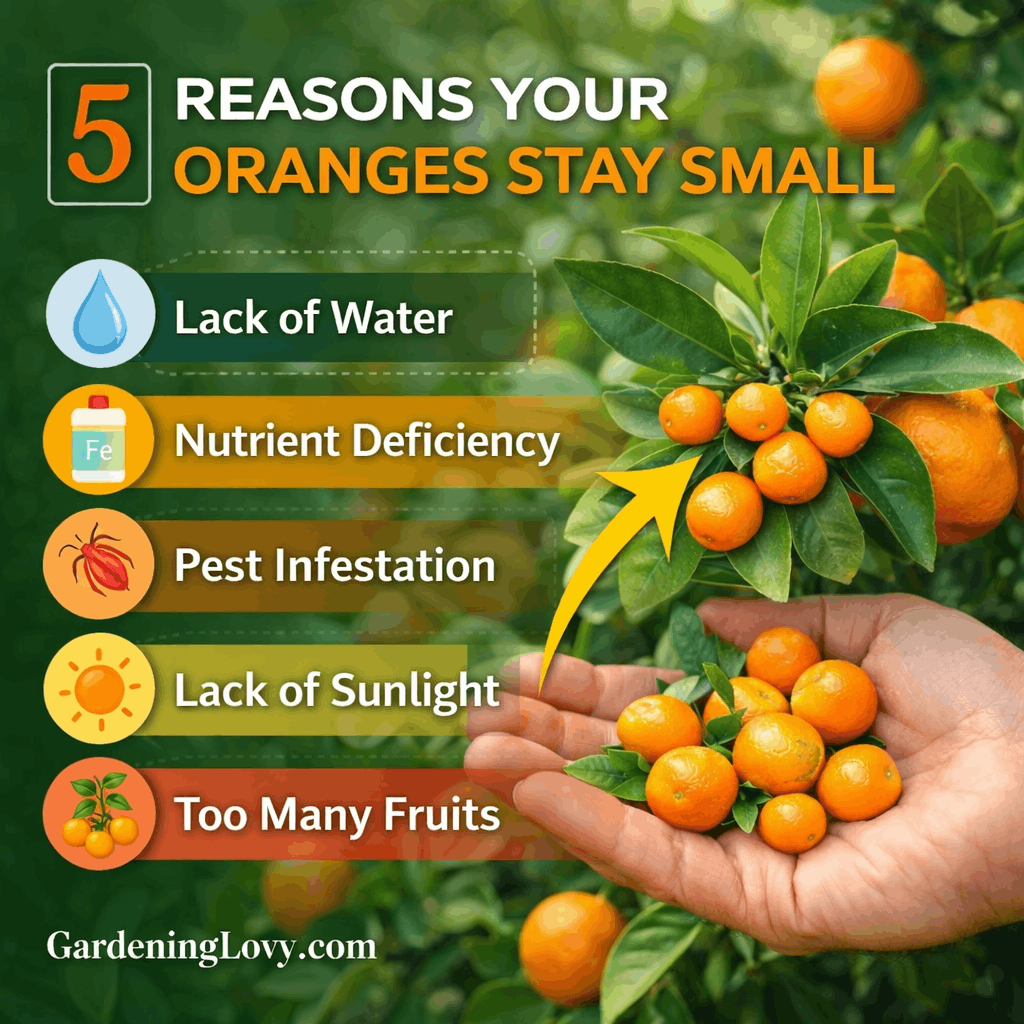
1. Watering Tends To Induce Little Fruit On Orange Trees
- For a fact necessary to survive, all trees necessitate frequent watering. This is particularly evident when your tree yields luscious fruit, such as oranges.
- Insufficient or inappropriate irrigation might induce your orange tree to become stressed and produce undersized fruit.
- When you don’t do it correctly, then watering every now and then might indeed barely be sufficient. Irrigation of the complete root system is required for citrus plants.
2. Nutritional Difficulty Can Also Induce Undersized Fruits
- Each orange plant’s distress can be triggered by a nutritional deficit, which could also lead to a tiny orange condition.
- A zinc shortage is one possible cause. Citrus plants’ foliage grows irregular green stripes along their veins once they don’t receive sufficient zinc.
- Your orange fruit might become yellowed and undersized, while leaf development will also become hindered.
- Administer a nutritional spray during the spring period and once again towards the latter of the warmer months to solve this issue. Manganese, zinc, plus Iron are included in such sprays.
3. Small Orange Issue And Insects Infestation
- Citrus rust mites have been some of the predatory insects which affect orange plants.
- The above mites cause a variety of abnormalities inside the fruit, notably undersized fruit atop your orange plants.
- Sudden orange fruit drops with foliage loss are other possible side effects.
- Examine the foliage of your orange tree for pale, suntanned areas including necrotic blotches. Annual miticide treatments can effectively avoid this problem.
Orange Tree Small Fruit: Symptoms vs Causes
When oranges stay small, the tree usually shows other warning signs. Identifying those signs helps diagnose the problem quickly.
| Tree Symptom | Possible Cause |
|---|---|
| Small fruit + yellow leaves | Nutrient deficiency |
| Small fruit + leaf curling | Aphid infestation |
| Small fruit + brown spots on fruit | Citrus rust mites |
| Small fruit + fruit splitting | Irregular watering |
| Small fruit + slow tree growth | Lack of sunlight |
| Small fruit + leaf drop | Severe water stress |
This quick comparison can help gardeners identify the real problem without guessing.
Propagation Of Orange
Clippings are the basic way to propagate orange plants at residence seeing as they grow stably and accurately mimic the original plant’s desirable fruiting qualities.
- Following the present season’s development has matured and also the blooms have fallen, cultivating orange plants from clippings around the late spring season or earlier summer.
- Within a week of collecting the orange clippings, start planning a growing pot. Half perlite, as well as part coarse quartz sand, should be used to populate 6-inch containers.
- Clippings off the end of a blooming orange stem should be 6 to 10 inches long. Choose those having a leafy end as well as a width of less than a quarter inch.
- Snip every one of the foliage off the branch of the orange clippings around its underneath section. Snip 50 percent of the foliage off the end, and just about any fading or young flowers and fruit that have grown.
- Apply 0.1 percent indolebutyric acid grounding enzyme talc to the sliced tip of your orange clippings. Use a dust-free paintbrush and perhaps a completely new cotton ball to spread the talc.
- Make a wide suitable sowing opening inside your perlite and sand combination to fit the bottom portion of your orange clipping. Inside the opening, place your hormone-treated tip of the clipping then gently push the perlite combination over the stalk.
- Within a moderately covered chilly frame and otherwise, inside your house close to a wide window featuring indirect sunshine, set your container orange clipping.
- As your orange clipping develops, keep your perlite combination wet at all times. To avoid rot as well as fungal diseases, let the uppermost inch of the soil completely air off before watering.
- 3 months following planting your orange clipping, inspect for root systems. Slightly pull on the stalk’s bottom to see whether the roots have glued it to your perlite combination.
Why Orange Trees Drop Fruits Prematurely

- Abnormal orange fruit drop could sometimes be triggered by a variety of nutritional inadequacies, and recognizing the specific nutritional shortage allows you to administer the appropriate plant food to rectify the problem.
- To minimize significant fruit fall as well as related citrus tree issues, proper water administration is essential. Fruit dropping can be triggered by overwatering, water-logged soils, as well as drought distress.
- Extreme trimming can trigger your orange tree to become stressed and lose quite so many leaves, resulting in fruit dropping.
- Very strong insect invasion can indeed induce orange fruit fall if your orange tree is stressed sufficiently.
- Fruit dropping on your orange tree could happen as a result of abrupt temperature fluctuations, specifically if extreme temperatures happen during or immediately following fruit development.
- Fruit dropping induced by brown rot could become an issue for orange trees grown in water-logged or low-lying areas over lengthy spells of warm and moist temperatures during late summer as well as autumn.
Tips For Growing Larger Orange Plants
Remember that your trees require additional fertilizers, water, plus sunlight over something else in order to develop larger oranges successfully.
Watering
Orange plants, particularly during the inactive seasons of each year, can typically endure mild dehydration situations.
The best circumstances for maximum development, nonetheless, involve frequent irrigation in well-drained ground.
Since such high wetness might encourage root rot, you really shouldn’t over water your orange trees as well as leave your soil soggy. Once your soil seems parched to the fingers, water it.
Orange trees need deep watering instead of frequent shallow watering.
Best practice:
• Water deeply every 7–10 days during warm months
• Ensure soil drains well
• Avoid constantly soggy soil
Deep watering helps the roots absorb enough moisture to support fruit development.
Light
Making certain your orange plant gets adequate exposure is amongst the most essential tasks you should be doing to stimulate its development.
Exposure aids your orange tree in producing the fuel required to propel fruit development. Position your orange tree under broad sunshine to make certain that it enjoys sufficient sun exposure.
If you’re going to grow your orange tree atop a cliff side, make certain it’s along with a south-facing inclination.
Furthermore, keep in mind that while trimming might guarantee that sufficient lighting penetrates your overall orange plant, it could also end in fuel being transported to fewer spots. Pruning should be done infrequently.
Apply Citrus Fertilizer
Generating delicious, luscious fruit may deplete soil vitamins and minerals significantly.
As a result, if you would like your orange tree to keep growing, the best alternative is to apply a nitrogen-rich plant food, such as one containing an N-P-K proportion of 3-1-1 or 2-1-1.
Citrus plants, particularly oranges, like somewhat acidic soil, thus a mildly acidic plant food could very well be advantageous.
Over the productive growth phase, fertilize once or twice per month, about once or twice a year over the inactive quarter.
Orange trees are heavy feeders. Lack of nutrients often results in smaller fruit.
Recommended fertilizer ratio:
| Nutrient | Role |
|---|---|
| Nitrogen (N) | Leaf growth and fruit size |
| Phosphorus (P) | Root development |
| Potassium (K) | Fruit quality and sweetness |
A fertilizer ratio of 3-1-1 or 2-1-1 works well for citrus trees.
Fertilize:
• Early spring
• Early summer
• Mid-summer if tree is fruiting heavily
Improve Soil Quality
Orange trees prefer well-drained, slightly acidic soil.
Ideal soil conditions:
| Soil Factor | Ideal Range |
|---|---|
| pH level | 6.0 – 6.5 |
| Drainage | Well drained |
| Organic matter | High |
Adding compost or well-aged manure helps improve soil structure, enrich organic matter, and provide essential nutrients that support healthy tree growth.
It also improves soil drainage and promotes beneficial microbial activity.
In addition, regularly monitor the tree for signs of nutrient deficiencies such as calcium, iron, magnesium, copper, and phosphorus, as these deficiencies can affect fruit size, leaf color, and overall plant health.
Correcting these nutrient imbalances early can help the tree produce healthier foliage and better-quality fruit.
Thin Excess Fruit
If your tree produces too many fruits, each fruit receives less energy.
To solve this:
• Remove smaller fruits early in the season
• Leave 4–6 inches space between fruits
This allows remaining fruits to grow larger and sweeter.
5. Monitor Pests Regularly
Common citrus pests include:
• Aphids
• Citrus rust mites
• Scale insects
• Mealybugs
Early detection prevents fruit damage.
Natural pest control options include:
• Neem oil spray
• Insecticidal soap
• Introducing ladybugs
Orange Tree Fruits Problems
Aphids
Aphids reproduce fast and do the maximum damage to orange plants over the growing season because they feast on fluid from the foliage.
Aphids create honeydew while they feed, a tasty goo that covers foliage that causes fungal infections, and also invites ants.
Aphid invasion is indicated by yellowing, coiled foliage studded in small bite holes.
Scales
The fruit stems, limbs and foliage of orange plants are devoured by California red as well as yellow scales.
Male scales have a short life span, coupling for just brief hours before dropping dead. Female scales survive lengthier.
They possess a spherical covering. They bind themselves securely to orange plants, producing crawlers as descendants.
Scales inflict considerable harm, including the loss of foliage, falling parts, and, in extreme cases, the whole orange plant’s death.
Mealybugs
Mealybugs, which are little and annoying, gather in protected areas on orange plants, lurking behind barks, amid bunches of foliage, including within branches.
Mealybugs secrete problematic honeydew whenever they feast on nectar from orange foliage.
Snails
Ravenous snails munch on their path to the top of orange trees, burying themselves in cracks as well as spreading a silvery mucus track in their path, to chew on each orange foliage as well as fruit.
Ideal Growing Conditions For Large Orange Fruits
For healthy fruit development, orange trees require the following environment.
| Requirement | Ideal Condition |
|---|---|
| Sunlight | 6–8 hours direct sunlight |
| Watering | Deep watering weekly |
| Soil | Well-drained sandy loam |
| Temperature | 60°F – 85°F |
| Fertilization | Every 6–8 weeks during growth season |
When these conditions are maintained, orange fruits typically grow larger, juicier, and sweeter.
Pests Control On An Orange Tree
- Unlike ordinary soaps, a pesticidal soap comprising potassium salts of saturated fats, which also affects the cellular components of insects as well as induces them to dry, destroys aphids even without damaging orange trees.
- The highest quality approach to reducing scale populations is to introduce ladybugs plus rapacious wasps, which are natural rivals of scales.
- While insecticides can kill mealybugs, adding enemies such as predatory wasps as well as ladybugs would help achieve the task without using chemical compounds.
- Snails utilize fallen foliage and waste for refuge, so eradicating them and cutting lower twigs they could climb onto will assist. Snail snares can also be placed at the bottom of orange plants to preserve them clear of snails.
Infection Of Orange Tree’s Bark and Trunk
Foot Root Fungus
Footrot fungus is generally indicated by blisters and cankers somewhere at the bottom of orange plants, specifically when the blisters exude fluids.
Such ailment is incurable. Affected orange trees should be eliminated and burnt. Cultivate orange trees inside the well-draining ground and prevent overwatering to reduce the possibility of your orange tree developing foot rot fungus.
When you have hard clay ground, you will need elevated beds plus ledges.
Infections Of Orange Fruits
Fruit Splitting
Fruit splitting so far has been triggered by inconsistency with watering as well as nourishing, not even by an illness.
The fruit splits apart before it can be collected due to this annoying problem. Moisture your orange plants thoroughly every one and two weeks, based on growth circumstances, to avert this situation.
Citrus Stubborn Disease
Leafhoppers are the carriers of the infection. To control leafhoppers, douse pesticide soap and otherwise oil on afflicted orange trees.
Infections Of The Foliage Of Orange Tree
Citrus Greening
It’s Asian citrus psyllid that spreads the above bacterial ailment, which produces yellow slight discoloration on orange foliage.
You may additionally observe that your orange plant’s mid-vein appears bigger and more noticeable. Even though there’s hardly any treatment for this condition, attentive maintenance may enable the tree to live.
Burn On The Tip Or The Margins Of Leaves
Yellowing around the ends or margins of your orange foliage is generally induced by an overabundance of salts within its ground, somewhat less by an illness.
Soak your orange plant’s ground on many occasions per year to assist dissolve and draining off the salts to solve this situation.
Quick Checklist: How To Prevent Small Oranges
Before the fruiting season begins, gardeners can use this checklist to prevent small fruit problems.
✔ Ensure full sun exposure
✔ Fertilize with citrus-specific fertilizer
✔ Water deeply but avoid waterlogging
✔ Prune lightly to improve sunlight penetration
✔ Inspect regularly for pests
✔ Thin excessive fruit early
Following these steps helps your orange tree focus its energy on producing healthy, full-sized fruit.
FAQs: small orange fruit on tree
Q1: Why Are My Oranges Shrinking In Size?
Insufficient moisture content is by far the most common explanation of the undersized orange fruit.
Q2: How Do You Make Oranges Grow Bigger?
Apply a nitrogen-rich plant food, such as one containing an NPK combination of 2-1-1 and perhaps 3-1-1, if you would like your orange plant to develop bigger in size.
Q3: Are Small Orange Berries Poisonous?
Small Orange Berries do seem to be dangerous in high quantities, causing difficulty in respiration, exhaustion, and convulsions.
Q4: How Might I Know What Sort Of Citrus Plant I Possess?
Examine the structure and dimensions of the foliage, fruits, as well as blossoms.
Conclusion: A Small Orange Fruits
While many farmers’ goal isn’t necessarily to grow the largest orange trees, most gardeners want healthy trees that produce sweet, juicy, well-developed oranges.
Small fruits on an orange tree usually indicate that the plant is under some form of stress — whether from water issues, nutrient deficiency, pest infestations, or environmental conditions.
Fortunately, with proper care such as balanced fertilization, consistent watering, good sunlight exposure, and regular pest monitoring, orange trees can recover quickly and begin producing larger, healthier fruits.
By maintaining the right growing conditions and addressing problems early, gardeners can ensure their citrus trees remain productive, vibrant, and capable of yielding high-quality oranges year after year.

I am an enthusiast who loves plants very much and I do a lot of research online as well as outside in gardens and nurseries. I also strive to be as accurate as possible in my research and my articles. I have been involved in gardening for a long time and truly enjoy it. Know more about me About. You can also join me Here.